99%+ HPLC Pure | Batch-Specific Third-Party COAs | Free Shipping Over $250

Dr. Rachel Kim | 5 hours ago

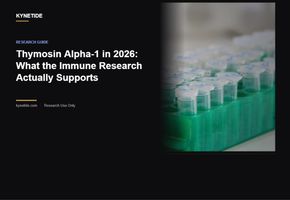
Thymosin Alpha-1 in 2026: What the Immune Research Actually Supports

A 2026 market-news look at why Thymosin Alpha-1 is drawing fresh research interest for immune health and healthy aging, and what the current evidence does and doesn't support.

Frequently Asked Questions

What is Thymosin Alpha-1 studied for? Thymosin Alpha-1 is studied for its immunomodulatory effects, including potential roles in cancer and viral infection research, as well as its effects on immune aging and vaccine response in older populations.


Is Thymosin Alpha-1 FDA-approved? No. It remains a research compound without FDA approval for general use in the United States, although related formulations are marketed under different names in some other countries.


Does the evidence support Thymosin Alpha-1 for viral infections like COVID-19? Current evidence synthesis does not support Thymosin Alpha-1 as a routine intervention for COVID-19, despite ongoing interest in its immunomodulatory properties.


How does Thymosin Alpha-1 relate to aging research? Research has explored its potential to mitigate immunosenescence, the age-related decline in immune function, and to improve vaccine response in elderly populations.


What should researchers keep in mind when sourcing Thymosin Alpha-1? Given its mixed international regulatory status, researchers should prioritize verified, batch-tested domestic research-grade material rather than assuming internationally marketed versions are equivalent substitutes.

Why Thymosin Alpha-1 Is Getting New Attention in 2026

Thymosin Alpha-1 (Ta1), a 28-residue peptide derived from prothymosin alpha, has re-emerged as a focus of immune-health research in 2026. Long studied in immunotherapy contexts, including cancer and viral infection research, the peptide has drawn renewed interest from researchers examining immune resilience and aging-related immune decline.


What the research says about immune aging. Preclinical and clinical research has explored Ta1's potential to improve vaccine response in older populations and mitigate immunosenescence, the gradual decline of immune function associated with aging. Some studies point to improved T-cell function as a proposed mechanism, an area of particular interest to longevity-focused researchers.


Where the evidence has limits. Despite the interest, current evidence synthesis has not supported Ta1 as a routine intervention for common viral illnesses, including COVID-19, reflecting a broader pattern in peptide research: mechanistic plausibility and early studies do not always translate into confirmed clinical benefit.


Regulatory and sourcing context. Thymosin Alpha-1 remains a research compound with no FDA approval for general use in the United States, even though a version is approved and marketed under different names in some other countries. For laboratory researchers, that split regulatory landscape makes sourcing discipline especially important, since compounds available internationally are not automatically appropriate substitutes for verified domestic research-grade material.


Conclusion: This article is provided for informational purposes only and summarizes publicly reported research coverage; it is not medical advice. Kynetide's compounds are sold strictly for laboratory research use and are not intended for human or animal consumption.


Related Research Peptides: Researchers studying immune-focused compounds can also review Kynetide's Thymosin Alpha-1 listing, shipped with a batch-specific, third-party Certificate of Analysis.
Let’s create what matters — together.

Dr. Rachel Kim

More Posts

KPV: The Anti-Inflammatory Peptide at the Center of the FDA's 2026 Compounding ReviewKPV: The Anti-Inflammatory Peptide at the Center of the FDA's 2026 Compounding Review
KPV: The Anti-Inflammatory Peptide at the Center of the FDA's 2026 Compounding Review

A 2026 market-news look at KPV, the alpha-MSH-derived tripeptide included in the FDA's upcoming July 23-24 Pharmacy Compounding Advisory Committee review, and what the research says about its proposed anti-inflammatory mechanisms.

DIY Peptide Dosing Is Surging in 2026 — Here's What the Safety Data Actually ShowsDIY Peptide Dosing Is Surging in 2026 — Here's What the Safety Data Actually Shows
DIY Peptide Dosing Is Surging in 2026 — Here's What the Safety Data Actually Shows

A 2026 market-news look at why self-directed peptide use is climbing, what clinicians and major outlets are warning about unsupervised dosing, and how researchers can reduce risk through verified sourcing and rigorous protocols.

Why Peptides Are 2026's Buzziest Wellness Trend — And Why Sourcing MattersWhy Peptides Are 2026's Buzziest Wellness Trend — And Why Sourcing Matters
Why Peptides Are 2026's Buzziest Wellness Trend — And Why Sourcing Matters

A 2026 market-news look at why peptides have become the year's defining longevity and biohacking trend, what physicians are warning about DIY use, and why verified sourcing matters more than ever.

BPC-157 in 2026: What the Latest Research Actually ShowsBPC-157 in 2026: What the Latest Research Actually Shows
BPC-157 in 2026: What the Latest Research Actually Shows

A 2026 market-news roundup of the peer-reviewed and preclinical research behind BPC-157, its current regulatory status, and the purity standards that keep tissue-repair research reproducible.

Peptide Market Snapshot 2026: Why the Purity Gap Is the Real StoryPeptide Market Snapshot 2026: Why the Purity Gap Is the Real Story
Peptide Market Snapshot 2026: Why the Purity Gap Is the Real Story

A 2026 market-news look at how fast the research peptide industry is growing, and why the widening gap between third-party HPLC-verified compounds and unverified gray-market imports matters more than the growth numbers themselves.

FDA's July 2026 PCAC Meeting: What the Peptide Compounding Debate Means for ResearchersFDA's July 2026 PCAC Meeting: What the Peptide Compounding Debate Means for Researchers
FDA's July 2026 PCAC Meeting: What the Peptide Compounding Debate Means for Researchers

A 2026 market-news briefing on the FDA's Pharmacy Compounding Advisory Committee review of seven bulk peptides — and why the outcome matters for research-grade sourcing standards.

MOTS-c & SS-31: Top Mitochondrial Peptides for 2026 Longevity ResearchMOTS-c & SS-31: Top Mitochondrial Peptides for 2026 Longevity Research
MOTS-c & SS-31: Top Mitochondrial Peptides for 2026 Longevity Research

A 2026 research-use-only deep dive into MOTS-c, SS-31, and the mitochondrial peptides driving longevity and cellular-energy research, plus the handling and third-party purity standards that keep results reproducible.

Retatrutide vs Tirzepatide 2026: Triple vs Dual Agonist Research ComparisonRetatrutide vs Tirzepatide 2026: Triple vs Dual Agonist Research Comparison
Retatrutide vs Tirzepatide 2026: Triple vs Dual Agonist Research Comparison

A 2026 research-use-only comparison of the triple agonist Retatrutide and the dual agonist Tirzepatide: receptor profiles, how each is studied in metabolic models, and the purity standards that support reproducible results.

BPC-157 remains one of the most widely studied peptides in tissue-repair and recovery research. This 2026 update reviews how the compound is investigated across gastrointestinal, tendon, and muscle models, its proposed angiogenic and anti-inflammatory mechanisms, and the reconstitution, storage, and third-party purity standards every lab should verify. For laboratory research use only.BPC-157 remains one of the most widely studied peptides in tissue-repair and recovery research. This 2026 update reviews how the compound is investigated across gastrointestinal, tendon, and muscle models, its proposed angiogenic and anti-inflammatory mechanisms, and the reconstitution, storage, and third-party purity standards every lab should verify. For laboratory research use only.
BPC-157 remains one of the most widely studied peptides in tissue-repair and recovery research. This 2026 update reviews how the compound is investigated across gastrointestinal, tendon, and muscle models, its proposed angiogenic and anti-inflammatory mechanisms, and the reconstitution, storage, and third-party purity standards every lab should verify. For laboratory research use only.

A 2026 research-use-only overview of how BPC-157 is studied across tissue-repair models, its proposed mechanisms, and the purity standards that support reproducible results.