A Certificate of Analysis (COA) is the single most important document that comes with a research peptide order, yet it's also one of the most overlooked. Knowing how to read one — and what to look for — turns an unfamiliar lab report into a clear signal of quality and identity. Here's a practical breakdown of what every COA should tell you.
Peptide Reconstitution 101: Bacteriostatic Water, Dilution Math & Storage
Reconstituting a lyophilized peptide correctly is one of the most important steps in any research protocol. Use too much or too little bacteriostatic water, and your concentration math (and your results) can be thrown off before you even start. Here's a clear walkthrough of the process our research team follows.
Why Reconstitution Accuracy Matters
Lyophilized peptides are stable in powder form, but the moment bacteriostatic water is added, the clock starts on both stability and concentration accuracy. Adding the wrong volume of water throws off the final concentration, which then throws off every downstream calculation for dosing volumes in a research protocol. Small errors in reconstitution compound quickly, so it pays to slow down and get the math right before drawing anything into a syringe.
Bacteriostatic Water and Basic Dilution Math
The basic formula is straightforward: total peptide (mg) divided by total water added (mL) gives you the concentration in mg/mL. For example, adding 2 mL of bacteriostatic water to a 5 mg vial yields a 2.5 mg/mL solution. From there, a standard insulin syringe marked in units (where 100 units equals 1 mL) makes it easy to draw an exact dose once the concentration is known. Always double check the math on paper before drawing up a dose, and use a fresh calculation any time the water volume changes.
A Step-by-Step Reconstitution Walkthrough
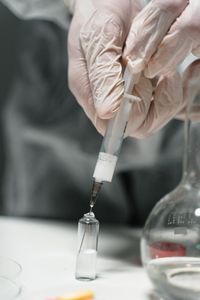
Start by letting a refrigerated vial and the bacteriostatic water reach room temperature before mixing, which helps the powder dissolve smoothly. Insert the needle into the water vial, draw the calculated volume, then inject it into the peptide vial by aiming the stream along the inside wall of the glass rather than directly onto the powder. Gently swirl the vial to dissolve the peptide completely; do not shake it, since vigorous agitation can damage the peptide's structure. Once fully dissolved, the solution should generally look clear, and any persistent cloudiness is worth double-checking before use.
Storing Reconstituted Peptides
Once a peptide is reconstituted, it should generally move straight into a refrigerator rather than sitting at room temperature. Most reconstituted peptides hold up best when used within a few weeks, though exact stability windows vary by compound, so it's worth checking guidance specific to what you're working with. Keep the vial away from light, label it with the reconstitution date, and avoid repeated temperature swings from taking it in and out of the fridge more than necessary.
A Quick Reconstitution Checklist
Before reconstituting, confirm the peptide amount printed on the vial, calculate the exact water volume needed for your target concentration, and have alcohol swabs, a clean syringe, and bacteriostatic water ready. During mixing, add water slowly along the vial wall and swirl gently rather than shaking. Afterward, label the vial with the date and concentration, refrigerate it promptly, and record your dosing calculations somewhere you can reference later. A consistent routine here removes most of the guesswork from every future draw.