A Certificate of Analysis (COA) is the single most important document that comes with a research peptide order, yet it's also one of the most overlooked. Knowing how to read one — and what to look for — turns an unfamiliar lab report into a clear signal of quality and identity. Here's a practical breakdown of what every COA should tell you.
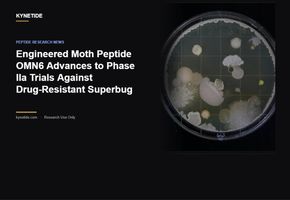
Engineered Moth Peptide OMN6 Advances to Phase IIa Trials Against Drug-Resistant Superbug
A cyclized Cecropin A analog called OMN6 wins ~€8M in EU funding and enters Phase IIa trials targeting carbapenem-resistant Acinetobacter baumannii pneumonia.
Antimicrobial peptides have been a research staple for decades, but very few have made it into human trials. That's what makes OMN6 — a peptide originally characterized in the immune system of the Cecropia moth — worth watching this month. Its developer, Omnix Medical, just secured roughly €8 million from the EU's Horizon Europe program, its second EU-backed initiative for the candidate, to help push the molecule toward Phase III.
The funding follows a June 2026 milestone: first patients dosed in a Phase IIa trial targeting hospital-acquired and ventilator-associated pneumonia caused by carbapenem-resistant Acinetobacter baumannii (CRAB), a pathogen the World Health Organization lists among its critical-priority targets due to mortality rates that can approach 60 percent in vulnerable patients.
From a Natural Defense Peptide to a Drug Candidate
OMN6 traces its lineage to Cecropin A, one of the original antimicrobial peptides isolated from insect immune systems in the early 1980s. Cecropin A kills Gram-negative bacteria through a physical mechanism: it folds into an amphipathic alpha-helix that inserts into and disrupts the bacterial outer membrane, rather than blocking a single enzyme or receptor. That non-enzymatic mode of action is part of why resistance is thought to be harder to evolve against peptides in this class. The limitation that kept natural cecropins out of the clinic for forty years was stability — like most unmodified peptides, they're degraded quickly by proteases once inside the body.
Omnix's re-engineering approach cyclizes the 40-residue peptide through a disulfide bond between terminal cysteine residues. That closed-loop structure slows proteolytic breakdown considerably while preserving the membrane-disrupting helix responsible for antibacterial activity. In published in vitro and animal data, the analog retained potent activity against multidrug-resistant and colistin-resistant A. baumannii strains, showed no meaningful activity against Gram-positive bacteria, and produced no measurable cytotoxicity or hemolysis at tested concentrations.
Why the Funding and Trial Stage Matter
For research teams tracking translational peptide chemistry, OMN6's progression is a useful case study in how a well-characterized natural peptide scaffold can be modified to address the pharmacokinetic weaknesses that typically stall peptide drug candidates: proteolytic instability, narrow therapeutic windows, and manufacturing complexity. The EU funding, layered on top of a $25 million Series C round in late 2025 and earlier NIH and Israel Innovation Authority support, also signals continued institutional confidence in cyclization and related stabilization strategies as a general approach for advancing antimicrobial peptide scaffolds beyond preclinical work. With the global pipeline for new Gram-negative antibiotics widely regarded as thin, OMN6's Phase IIa results will be a relevant data point for the broader antimicrobial peptide field regardless of the eventual clinical outcome.
For research use only. Not for human consumption.
FAQ
What is OMN6? OMN6 is a 40-amino-acid cyclic peptide engineered from Cecropin A, a naturally occurring antimicrobial peptide first isolated from moth pupae, and stabilized via a disulfide-bonded cyclic structure.
What organism does OMN6 target? It targets carbapenem-resistant Acinetobacter baumannii (CRAB), a Gram-negative bacterium the WHO classifies as a critical-priority drug-resistant pathogen.
What clinical stage is OMN6 in? OMN6 entered a Phase IIa trial in June 2026, with first patients dosed for hospital-acquired and ventilator-associated pneumonia.
Why does cyclization matter for peptide stability? Cyclizing a peptide's structure through a bond like a disulfide bridge can substantially slow degradation by proteases, addressing one of the most common pharmacokinetic barriers to peptide drug development.
Sources
American Peptide Society, "From Moth to Medicine" (2026); Mandel S. et al., Scientific Reports (2021); Antibiotics (2022); GlobeNewswire, Phase II trial and Series C announcements (2025-2026).